
Nevada Southern Release Paths
Nevada Southern Detention Center is a private contract detention site operated by CoreCivic under an agreement with the U.S. Marshals Service. ICE is also an authorized user. That structure makes the custodian, meaning the agency legally responsible for the person, more important than the building name. A person may leave for the community under a federal court order, move to another USMS contract jail, enter BOP custody after sentencing, transfer within ICE detention, or leave ICE custody. Each event produces a different record.
A facility departure alone does not establish freedom. The strongest confirmation pairs the facility movement with the controlling agency's record. A federal pretrial release is best supported by the federal docket and court order. A BOP sentence is checked through the BOP locator once the person has entered that system. Current or recent ICE custody is checked through ICE ODLS and, when needed, Enforcement and Removal Operations support. The broader Nye County released-inmate search explains how those federal paths differ from a county-jail release.
| Custodian | Possible departure | Best confirmation |
|---|---|---|
| USMS | Court release or contract-facility transfer | Federal docket, court, counsel, or USMS |
| ICE | Community release or ICE transfer | ICE ODLS, ERO, and facility movement |
| BOP | Federal prison release or transfer | BOP Inmate Locator and federal docket |
| CoreCivic facility | Physical departure from NSDC | Facility confirmation subject to custodian limits |
Confirm Nevada Southern Release
Begin with identity and case type. Use the full legal name, date of birth, and any A-number, BOP number, FBI number, INS number, federal case number, or facility identifier that is lawfully available. Ask Nevada Southern Detention Center which agency controls the custody and whether the person remains at the site. Staff may be limited in what they can disclose, but even a custodian identification prevents a search in the wrong federal system.
- Identify the custodian. Determine whether the case belongs to USMS, ICE, or BOP. Do not infer agency from the facility name alone.
- For a pretrial federal case, check the court. Read the detention or release order and later docket entries. USMS has no public historical release locator.
- For an ICE case, search ODLS. Use the A-number route or the biographical route, then call ICE if the expected record does not appear.
- For a BOP case, use the federal locator. A past release date or “RELEASED” status concerns BOP custody only.
- Reconcile the records. Compare the agency result with facility movement and the court authority before calling the event a community release.
CoreCivic does not replace the sovereign agency's record. Likewise, BOP should not be treated as the default source for every federal detainee. USMS generally handles federal prisoners before and during trial, while BOP becomes relevant after commitment. ICE detention follows a separate civil immigration system.
Nevada Southern Records Contact
The current CoreCivic facility page is the direct source for the operator's contact details. Use the facility phone to confirm the exact site and ask which agency has custody. Requests for the legal release record should then go to that custodian or to the federal court. A private operator's front desk is not a substitute for an agency locator, docket, or official records process.
Nevada Southern Detention Center
Operator: CoreCivic under USMS agreement; ICE is an authorized user
CoreCivic address: 2190 E. Mesquite Avenue, Pahrump, NV 89060
Main phone: 775-751-4500
ICE address note: ICE material may list ZIP 89048 for the same street address
The ZIP code difference should remain source-specific. CoreCivic uses 89060, while an ICE directory may display 89048. Neither should be silently changed to make the sources look identical. When writing or calling, give the facility name, street address, person identifiers, and controlling agency. Ask whether the record reflects a transfer, a court-authorized release, or another disposition.
The operator's current facility listing provides a useful visual check on the name and location.
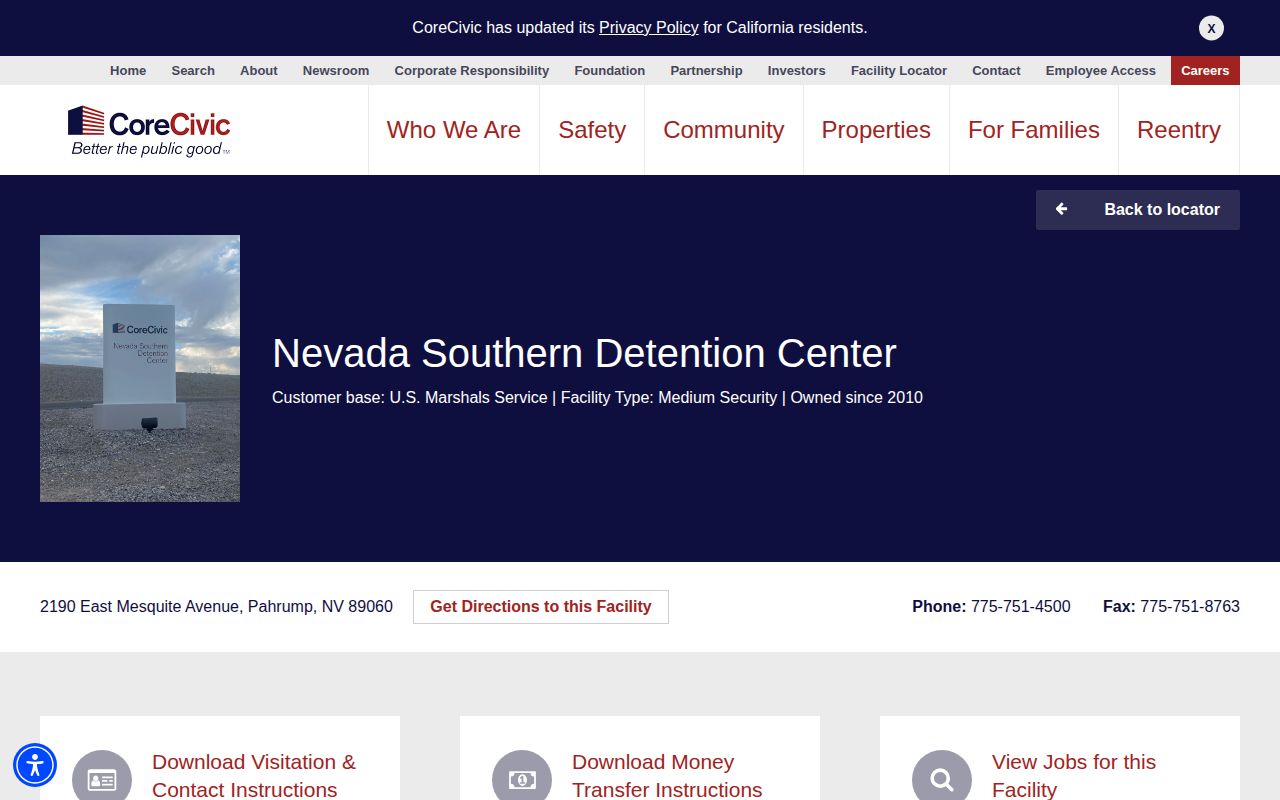
That listing confirms the operating contract site, but the responsible federal or immigration agency still controls a person-specific release record.
Nevada Southern ICE Releases
The ICE Online Detainee Locator System accepts either a nine-digit A-number with country of birth or exact first and last name with country of birth and optional date of birth. Leading zeros may be needed to make an A-number nine digits. ICE says ODLS can include current detainees and many people released from ICE custody within the prior 60 days. It is not a permanent release archive.
Some people are excluded because of age, security, discretion, or data delay. If facts support ICE custody but ODLS returns no match, call the ICE Detention Reporting and Information Line at 1-888-351-4024, Monday through Friday, 8 a.m. to 8 p.m. Eastern. Ask about current or recent ICE custody. A missing result does not prove that a person entered the community.
Nevada Southern Federal Records
The BOP Inmate Locator accepts a BOP Register, DCDC, FBI, or INS number. It also offers a name search with age, race, and sex filters. According to BOP's locator record explanation, a past release date with no listed facility, or a location shown as “RELEASED,” means the person is no longer in BOP custody. A future date is projected, while “UNKNOWN” means the term has not been determined.
Those labels are useful only if BOP actually held the person. They do not show release from Nevada Southern Detention Center under USMS authority, release from ICE, or completion of federal supervision. Locator coverage generally begins in 1982. Older federal records follow the archival routes described by BOP. The federal docket remains essential because it identifies detention orders, sentencing, later release authority, and the court handling the case.
- USMS custody
- Federal prisoner custody commonly used before trial and during court proceedings.
- BOP custody
- Federal prison custody after commitment to the Bureau of Prisons.
- ICE custody
- Civil immigration detention, separate from a federal criminal sentence.
- Detainer
- A request that another agency notify ICE and, in stated circumstances, hold a person briefly for transfer.
Pahrump Custody Handoffs
Pahrump contains two separate facilities with documented federal or immigration roles. Nevada Southern Detention Center is the CoreCivic contract site on Mesquite Avenue. Nye County Detention Center is the county-owned jail on Siri Lane, and a 2022 ICE inspection documented ICE and USMS use there as well. The shared city does not make them the same jail.
An ICE detainer tells a law-enforcement agency that ICE intends to assume custody, requests notice of release, and asks for continued custody for up to 48 hours in specified circumstances. Thus a local record can accurately close as “released” while ICE custody starts. A move from the county jail to Nevada Southern, or from Nevada Southern to another ICE or USMS site, is a transfer rather than community release.
The official ICE detainer explanation also shows why the word “released” must be read with the receiving agency.
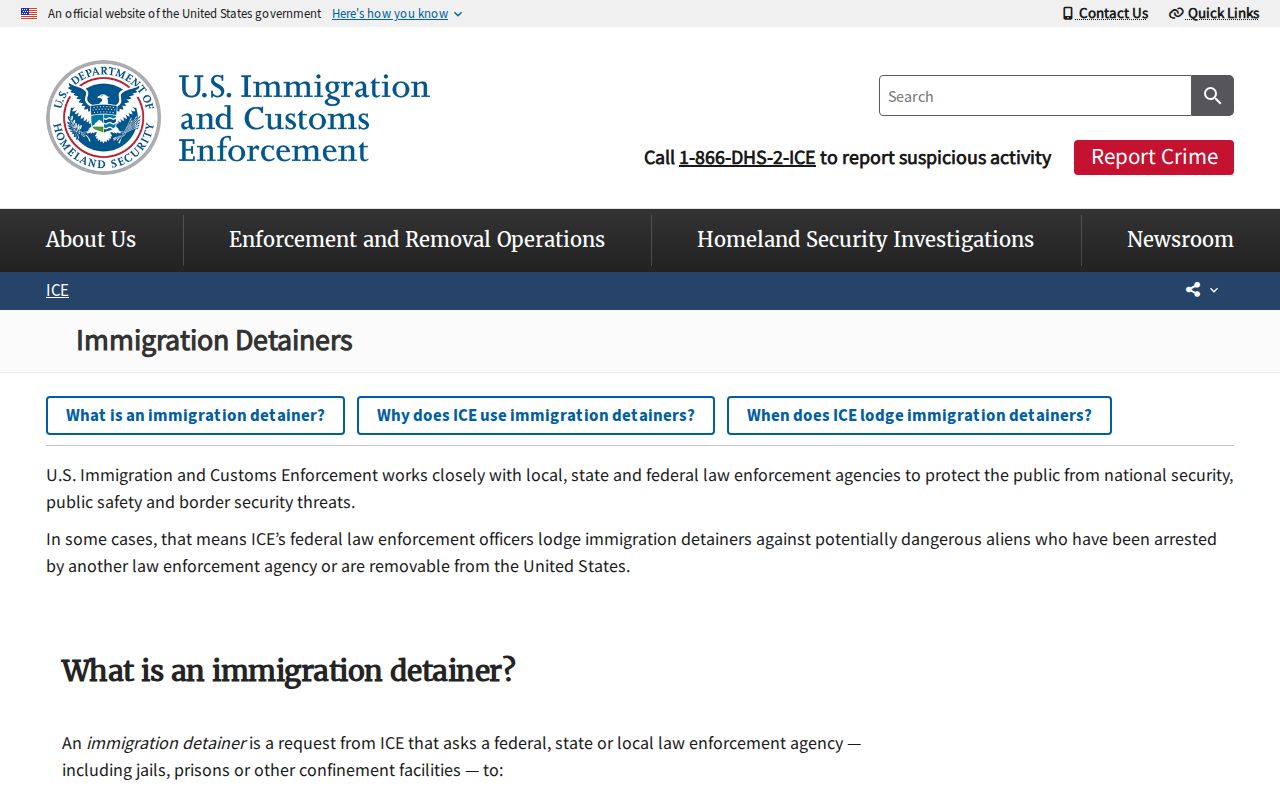
The image supports the handoff distinction. It does not identify any individual or prove that a specific transfer occurred.
Ask for the full facility name, controlling agency, destination, and date of movement. This Angle K distinction prevents a false conclusion based on a building departure. It also explains why searching all federal systems at once can produce conflicting or empty results: each database has a defined jurisdiction.
Nevada Southern Custody Role
Nevada Southern Detention Center opened in 2010 and began housing ICE detainees in 2016 under the Salt Lake City Field Office, according to ICE's 2024 inspection. Current operation is supported by that inspection, CoreCivic's active facility page, 2025 to 2026 USMS reporting, and a March 2026 PREA audit date. PREA refers to the federal Prison Rape Elimination Act audit framework.
These sources support the facility's operating status, but they do not create a public release list. USMS prisoner tracking data are internal, and USMS policy limits release of federal-prisoner photographs, personal histories, and arrival or departure times. Facility confirmation may therefore be narrow. For documentary proof, obtain the federal court's order and the agency record that matches the custody type.
A transfer, projected date, and completed release are three separate events. Record the exact status label and the date checked. If sources conflict, ask the responsible custodian to reconcile them instead of choosing the result that appears most convenient.